Brief history of the taxi in San Miguel
The San Miguel Radio Taxi Association was constituted on ………………….. It currently has 40 licences for public service vehicles, 3 of which are adapted for people with reduced mobility, the so-called PMR.
To talk about taxis in the south of Tenerife and specifically in San Miguel, and more specifically about taxi drivers, is to recognise first class witnesses who have lived and participated in the social, cultural and economic life of the municipality.
Each family of taxi drivers contains a multitude of anecdotes and experiences that have taken place over the last 60 years. There is no specific publication relating to the municipality of San Miguel, but we extract some passages from the one entitled El acontecer del TAXI en ARONA by Marcos Brito, published in 2011, which gives an extensive history of all the professionals who have participated in the life of the taxi in the municipality of Arona and therefore we can translate it to the taxi drivers of San Miguel, given the neighbourhood and situations in many cases quite similar.
We extract the most relevant details from the aforementioned book, which can be summarised in the following paragraphs:
The roads and motorways in the south of Tenerife are, to put it familiarly, from the day before yesterday.
It was not until the middle of the 20th century and especially since the 60s and 70s that the capital and the neighbouring municipalities were connected. Until then, the main means of transport was the coastal ships, and in the beginning it was the local carriages or lorries that served as multi-purpose transport.
From the 1940s onwards, the old road to the south reached the municipality of San Miguel, and at the end of the 1960s, the motorway to the south was built to connect the south with Santa Cruz de Tenerife.
In the mid 20’s of the 20th century, small multi-purpose lorries proliferated: transferring goods from the midlands to the coast, transporting workers or bringing staff to all kinds of festivities.
“The first public service car on the roads and tracks in the south of Tenerife. Adeje, Granadilla de Abona, Arona, Médano and Los Cristianos. Property of Mr. Luis González Barroso”.
It is known that there were unregistered vehicles moving people to errands and celebrations in the 30’s and 40’s, both neighbours and members of the town council or the board of education.
Licences to operate with auto-tourist cars, later renamed auto-taxi, began to be granted at the end of the 1950s.
It was in these years that the taxi ranks were born, at first in a completely artisanal manner, maintained by the drivers themselves. With the boom in tourism, with the development that followed the inauguration of the motorway, the population and the transit of passengers through the Port of Los Cristianos multiplied, with greater demand for services, and with the subsequent opening of the southern airport, the demand for day and night transport multiplied.
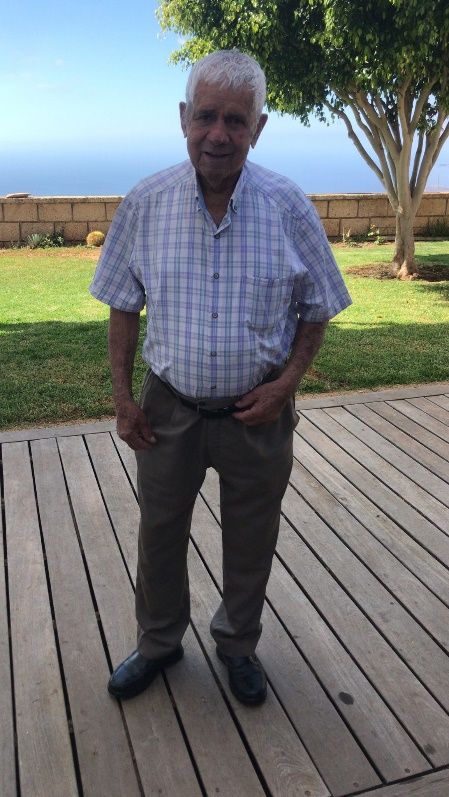
The first car he owned was a green Peugeot 404 7-seater, with registration number TF-26711, later he bought two more Peugeot cars and finally a Mercedes 300D with registration number TF-4072-AP.
In the 1960s and early 1970s, until the arrival of the “Autopista del Sur” and later the airport, the daily work consisted mainly of pirating, that is to say, they were pirate cars because in order to be profitable they picked up several people from different places until the quota was filled. The trips, which were contracted by calling the days before or by visiting to be picked up, started at 4 a.m. in order to arrive at 7 a.m. in S/C, after making a stop, often in Güimar. Most of the trips were for medical consultations, but also for administrative purposes or to travel by boat (mainly to other islands). The return trip was in the middle of the afternoon and the round trip cost about 45 pesetas.
Negative or at least annoying memories were the continuous dizziness of many people who vomited in the car and even on the back of the person in front of them. The arguments to go in the middle seat and not in the back. Transporting families who did not get on well together without it being a grievance for both. The stops made by the Guardia Civil de Tráfico and the so-called Guardias Civiles camineros to transport them free of charge from one place to another.
As a funny or somewhat amusing anecdote, he tells how he picked up a lady who he thought had a handicap because of the way she moved and whom he had to help to sit her in the car. She insisted that he take her to the Hotel Oro Negro in Playa de Las Américas and he kept banging her on the back. When she arrived at the hotel, the receptionist told her that she was drunk.